


Raising Future Thinkers | Ages 3–4
Raising Future Thinkers | Ages 3–4
Thirty activities, five minutes each, made for the age of sorting, comparing and asking why.
- Includes 30 screen-free activities.
- Backed by peer-reviewed research.
- Builds core skills for a future with AI.
- Simple, fun & easy to follow.
Couldn't load pickup availability
- Sent instantly
- No subscription
- Age appropriate
Raising Future Thinkers | Ages 3–4
About this guide
About this guide
Three- and four-year-olds sort, compare and ask why all day long. This guide turns those moments into thirty activities, five minutes each, that build the six skills research points to as lasting human strengths in a world shaped by AI.
At this age the reason matters more than the right answer. When your child says the banana doesn't belong "because it's food and the others are animals," that "because" is the skill you're building.
What’s inside
What’s inside
- 30 activities across six core skills: Critical Thinking, Systems Thinking, Creative Thinking, Adaptability, Curiosity and Emotional Intelligence.
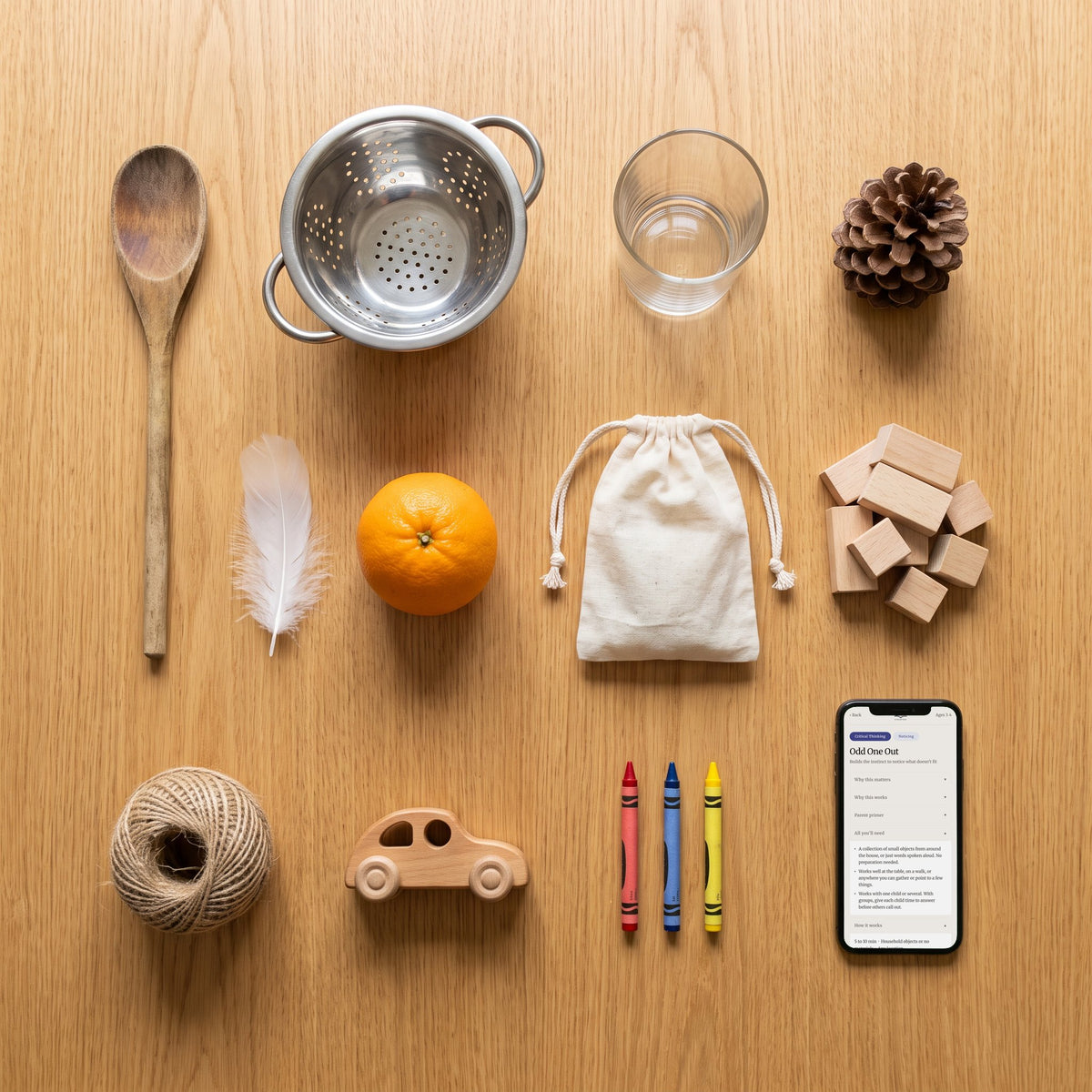
- Five minutes each, with everyday objects or nothing at all. Try Odd One Out at the breakfast table or And Then? on a walk.
- The research behind every activity, in plain language.
- What to notice, the questions to ask, and how to make each activity easier or harder.
- Progress tracking, so you can see which skills you've worked on.
How you get it
How you get it
A private link appears on the thank-you page and in your confirmation email. It's yours to keep.
The research
The research
Every activity ends with a short note on the research behind it: the study, who ran it, and what it means at your child's age, in plain language.


What does the future ask of your child?
AI is changing how people learn, work and solve problems, and the tools will keep changing as your child grows up. Nobody can say exactly what work will look like twenty years from now. What research can point to is which human skills keep their value as AI takes on more.

Six skills, five activities each
The skills research points to as lasting human strengths in a world shaped by AI. Tap a skill to read how the guide teaches it.
-
Critical Thinking
Thinking for themselves starts earlier than you think.
Five habits: noticing when something's off, asking why, testing a claim, spotting what's assumed, and judging whether an explanation holds together. Each activity trains one, in the ordinary moments of a day.
-
Systems Thinking
Notice how things connect, how actions travel.
Five lenses on how things connect: cause and effect, connections, ripples, loops, and wholes made of parts. Each activity uses the most hands-on version a 3 or 4 year old can reach.
-
Creative Thinking
More answers. Stranger answers. Something nobody thought of before.
Five habits: many ideas instead of one, combining ideas, seeing from a new angle, improving a first try, and making something original. Each activity trains one while the instinct is at its strongest.
-
Adaptability
Plans change. Feelings arrive. Keep going anyway.
Five skills: staying okay when plans shift, trying again, changing course partway through, acting without the full answer, and managing big feelings. Each activity practices one in a small, low-stakes moment.
-
Curiosity
Questions matter more than answers at this age.
Five habits: wondering out loud, following a question further, testing it hands-on, linking something new to what they know, and choosing what to explore. No activity needs an answer at the end.
-
Emotional Intelligence
Name it. Understand it. Recognize it in others.
Five skills: naming their own feelings, reading someone else's, seeing a moment from another side, noticing their own patterns, and reflecting on how they figured something out. Each one starts with a pause and a question.
How each skill builds
Six skills, each grown from five habits in a fixed order. Each habit builds on the one before it. When all thirty feel easy, the next guide grows the same tree a step further.
- Noticing
- Questioning
- Evidence
- Assumptions
- Evaluating Reasoning
- Cause & Effect
- Connections
- Ripple Effects
- Feedback Loops
- Whole vs Parts
- Generating Options
- Combining Ideas
- Reframing
- Iteration
- Original Synthesis
- Tolerating Change
- Trying Again
- Pivoting
- Ambiguity Comfort
- Self-Regulation
- Wondering
- Exploring
- Investigating
- Connecting Dots
- Self-Directed Learning
- Naming Feelings
- Reading Others
- Perspective-Taking
- Self-Awareness
- Metacognition
Try one activity
One of the thirty, taken from the guide. Try it today.
Odd One Out
Before a child can spot a flaw in an argument, they need a more basic skill: noticing when something doesn't fit. Odd One Out gives that instinct somewhere to practice, at the table, on a walk, or anywhere you can point to a few things.
Before a child can spot a flaw in an argument or question a claim, they need a more basic skill: noticing when something doesn't fit. The ability to scan a group of things and register "one of these is different" is the earliest form of evaluative attention. It's the instinct that later becomes "wait, that doesn't make sense."
Pattern recognition and categorization are among the most fundamental cognitive tools a child develops. Training them early, through play, builds the habit of looking for what belongs and what doesn't. That habit transfers directly to how a child processes information for the rest of their life.
Children aged 3 to 4 are active pattern-seekers. Research on preschool cognitive development confirms that children this age spend considerable effort organizing the world into categories, noticing similarities, and identifying exceptions. Piaget's work on preoperational thinking established that while 3 and 4 year olds can reliably categorize by a single attribute (color, shape, function), they are still developing the ability to hold multiple classification rules in mind at once. This makes the odd one out format ideal for this window: it plays to a real strength (pattern recognition) while gently stretching toward the next level (explaining why something doesn't fit).
The act of explaining the answer matters as much as finding it. When a child says "the banana doesn't belong because it's food and the others are animals," they are practicing the most foundational move in critical thinking: giving a reason.
References: Piaget, J. (1952), The Origins of Intelligence in Children; Gelman, S.A. & Markman, E.M. (1986), "Categories and induction in young children," Cognition; Cliffsnotes (2023), "Cognitive Development: Age 2-6."
This age group categorizes confidently but narrowly. Your child may give an answer you didn't expect, based on a rule you hadn't considered. Resist correcting them if their reasoning is internally consistent. "The apple doesn't belong because it's red and the others aren't" is a valid answer even if you were thinking about something else entirely. What you're building is the habit of noticing and explaining, not the habit of getting the "right" answer. Accept any answer that comes with a reason. Push back gently only when no reason is offered at all.
- They offer a reason without being asked. "That one doesn't belong because..." unprompted is the signal. The answer matters less than the because.
- They spot a second valid odd one out. More advanced children will notice that the same group can be sorted differently depending on the rule. That's a significant cognitive step.
- They start making their own groups and asking you to find the odd one out. Creating the puzzle is harder than solving it. That's the skill internalizing.
- A collection of small objects from around the house, or just words spoken aloud. No preparation needed.
- Works well at the table, on a walk, or anywhere you can gather or point to a few things.
- Works with one child or several. With groups, give each child time to answer before others call out.
1.Present four items, either physically or by saying them aloud. Three should share something in common. One should break that pattern.
Example: "Apple, banana, orange, spoon." The spoon doesn't belong because the others are fruit. Or try: "Dog, cat, fish, chair." Or for a harder version: "Red ball, red cup, red apple, blue block." Start simple, one obvious shared quality.
2.Ask: "Which one doesn't belong?" Then wait. Give them plenty of time before adding any prompt.
3.When they answer, always ask: "Why?" even if the answer is obviously right. The reason is the skill. A correct answer with no reason is less valuable than a slightly off answer with a clear reason.
4.Accept any answer that has a defensible reason behind it. If their reasoning surprises you, explore it. "Oh, interesting. Why does that make it different?"
5.Run two or three rounds, varying the category each time. Swap roles when they're ready: let them set the group and ask you to find the odd one out.
Which one doesn't belong?
The opening question every time. Simple and open. Doesn't hint at the category.
Why doesn't it belong?
Ask this every time they answer, whether right or wrong. The reason is the whole point.
Could any of the others be the odd one out?
Use when they've found one answer. Pushes them to notice that the same group can be sorted in more than one way.
If the difficulty level is right, they identify the odd one out quickly, offer a reason with a little prompting, and want to go again. They're curious rather than frustrated.
Use categories that share more than one quality, so the odd one out is less obvious. Or use five items instead of four. Or ask them to find a second valid odd one out from the same group.
Use physical objects they can touch and move rather than words. Make the category obvious: three animals and a cup, three red things and one blue. Let them handle the objects before answering.
If your child is still engaged and wants to keep going, try one of these.
- Let them set the group and challenge you. Creating a puzzle requires them to think about the rule first, then build around it. Harder than it sounds for a 3-year-old.
- Play it with people instead of objects. "We're all sitting down, but Dad is standing. Dad is the odd one out." Extends the concept into the world around them.
- Try abstract categories: sounds, actions, feelings. "Clapping, jumping, sleeping, waving." Which doesn't belong? Now the category rule is less visible, which makes the reasoning harder.
Watch for moments when your child spontaneously notices that something is out of place. A sock in the fruit bowl. A book on the kitchen counter. "That doesn't go there." These are not small moments. They're the same cognitive move as the activity, just applied to the real world unprompted. Name it when you see it. "Good eye. You noticed that didn't belong."
Final thoughtThe child who notices what's out of place is already thinking critically. The game just gives that instinct somewhere to practice.
Twenty-nine more like this, across all six skills.
30 purposefully designed activities
Every activity is built the same way, so you always know what you’re doing and why.

-
One skill, one habit
Each activity trains a single habit inside one of the six skills, so you know what you’re building.
-
The research, in plain language
A short note on the study behind it: who ran it, what they found, and what it means at your child’s age.
-
Things you already have
Household objects or nothing at all. No printing, no shopping, no setup.
-
Clear steps and what to say
Numbered steps and play prompts you can read once and run straight away.
-
A primer for you
What to expect at this age, the instinct to hold back on, and the signs the skill is showing up.
-
Easier, harder, further
How to adjust when it’s too easy or too hard, and ideas for when your child wants more.
What parents say
-
5 out of 5
My kids are loving this!
Simple games, easy to follow and lots of variation when I'm stuck for what to do.
-
5 out of 5
Nice Job Team
Parent tips are a nice touch to steer the game back in the right direction if it's getting off track
-
5 out of 5
just what i was looking for
wasn't so easy to find an activity book that uses research. so glad i found this
How we compare
Thirty activities, each built around a named skill and the research behind it, and each small enough for five minutes of an ordinary day.
| What you get | Raising Future Thinkers | Free ideas online | Typical activity book |
|---|---|---|---|
| Built around | Six named skills, five habits each, taught in order | Whatever turns up in a search | Usually a theme or a season |
| The research | Every activity names the study behind it, in plain language | Rarely sourced | Sometimes a general note at the front |
| Age fit | Written for one age band, so every activity fits | Often "ages 3 and up" | Often a wide range, like 3 to 8 |
| Time and materials | Five minutes, with things you already have | Varies, often printables or supplies | Often a materials list to gather first |
| Help for you | What to notice, and how to make it easier or harder | Usually the instructions only | Usually the instructions only |
| Progress | See which skills you've worked on | Nothing to track | Rarely |
| What comes next | The next age's guide grows the same six skills | Start the search again | A new book with a new approach |
Any last questions?
Do I need special skills or teaching experience to use this?
Do I need special skills or teaching experience to use this?
Not at all. Each activity is written in clear, simple steps, with prompts to help if your child gets stuck. You don’t have to prepare lessons or explain complex ideas, you just show up and play together. The learning happens naturally through fun.
What if my child isn’t interested in the activities?
What if my child isn’t interested in the activities?
Children learn best when they’re having fun and following their own interests. That’s why the guide is flexible. You can skip, adapt, or repeat activities depending on what excites your child that day. And for every activity, we've included helpful tips and prompts to keep everyone engaged.
How do I know these activities are actually effective?
How do I know these activities are actually effective?
Every activity is built around a specific core skill supported by child development research. The methods, like storytelling, open-ended play, and problem-solving, are backed by peer-reviewed studies. We’ve included references for every activity so you know this isn’t guesswork. It’s joyful play with a solid foundation.
What if I don’t have the time to add something new to our busy days?
What if I don’t have the time to add something new to our busy days?
That’s exactly why this guide was created. Most activities take 5 to 10 minutes and use things you already have at home. You don’t need to follow it in order or do everything. Pick what feels doable, even once a week. Small, playful moments are enough to make a big difference.
Why buy this when I can just find activities for free on the internet?
Why buy this when I can just find activities for free on the internet?
You absolutely can. But what this guide gives you is structure, clarity, and peace of mind. No endless scrolling or second-guessing if it’s age-appropriate or worthwhile. Instead, you get 30 ready-to-go activities, beautifully designed, research-backed, and organized so you can spend less time searching and more time connecting with your child.
How do I get the guide?
How do I get the guide?
Right after you pay, a private link appears on the thank-you page and in your confirmation email. Open it whenever you like, as often as you like. It's yours to keep.
Can I use it with more than one child?
Can I use it with more than one child?
Yes. Many activities work with siblings together, and where one child at a time works better, the activity says so. If your children are in different age bands, each band has its own guide.
Thirty activities across six skills, five minutes each.
Guides for other ages
The same six skills, with activities written for each age.

