


Raising Future Thinkers | Ages 5–6
Raising Future Thinkers | Ages 5–6
Thirty activities, five minutes each, made for children starting to hold two ideas at once.
- Includes 30 screen-free activities.
- Backed by peer-reviewed research.
- Builds core skills for a future with AI.
- Simple, fun & easy to follow.
Couldn't load pickup availability
- Sent instantly
- No subscription
- Age appropriate
Raising Future Thinkers | Ages 5–6
About this guide
About this guide
Five- and six-year-olds can start holding two ideas at once. They can sort by more than one feature, check a claim, and plan a step ahead. This guide gives that new thinking thirty activities, five minutes each, across the six skills research points to as lasting human strengths in a world shaped by AI.
The activities ask for a little more than at three or four: simple evidence, rules, and two or three steps in a row. Everything stays concrete and hands-on.
What’s inside
What’s inside
- 30 activities across six core skills: Critical Thinking, Systems Thinking, Creative Thinking, Adaptability, Curiosity and Emotional Intelligence.
- Five minutes each, with everyday objects or nothing at all. Try Prove It with a claim from dinner, or Plan B before a trip to the park.
- The research behind every activity, in plain language.
- What to notice, the questions to ask, and how to make each activity easier or harder.
- Progress tracking, so you can see which skills you've worked on.
How you get it
How you get it
A private link appears on the thank-you page and in your confirmation email. It's yours to keep.
The research
The research
Every activity ends with a short note on the research behind it: the study, who ran it, and what it means at your child's age, in plain language.


What does the future ask of your child?
AI is changing how people learn, work and solve problems, and the tools will keep changing as your child grows up. Nobody can say exactly what work will look like twenty years from now. What research can point to is which human skills keep their value as AI takes on more.

Six skills, five activities each
The skills research points to as lasting human strengths in a world shaped by AI. Tap a skill to read how the guide teaches it.
-
Critical Thinking
Looking twice, on purpose, before believing.
The same five habits, a step further: a second pattern, the source of an idea, a check instead of a hunch, a named assumption, and a real reason told apart from one that only sounds like one.
-
Systems Thinking
One change. Then another. Then many.
Five lenses, past the first link: changing one thing at a time, following a ripple two steps, predicting a chain, spotting a loop that grows, and finding which parts a whole can't do without.
-
Creative Thinking
More ideas, aimed at something that matters.
Five moves that give ideas somewhere to land: solutions to a real problem, two ideas combined, a new way to see a disappointment, improving on purpose, and planning an original idea before making it.
-
Adaptability
Ready before the change arrives.
From reacting to change toward getting ready for it: a plan B made in advance, frustration named, a switch of approach, a guess on partial clues, and a calming tool your child chose.
-
Curiosity
Some questions get answered. Some just get better.
Wondering with judgment: sorting questions they can test from ones that stay open, picking the mystery that matters most, testing more than once, comparing exactly, and choosing what to follow next.
-
Emotional Intelligence
Feelings rarely arrive one at a time.
Holding two things at once: two feelings about one moment, the situation as well as the face, their feeling beside someone else's, a pattern in what sets them off, and more than one way to know.
How each skill builds
Six skills, each grown from five habits in a fixed order. Each habit builds on the one before it. When all thirty feel easy, the next guide grows the same tree a step further.
- Noticing
- Questioning
- Evidence
- Assumptions
- Evaluating Reasoning
- Cause & Effect
- Connections
- Ripple Effects
- Feedback Loops
- Whole vs Parts
- Generating Options
- Combining Ideas
- Reframing
- Iteration
- Original Synthesis
- Tolerating Change
- Trying Again
- Pivoting
- Ambiguity Comfort
- Self-Regulation
- Wondering
- Exploring
- Investigating
- Connecting Dots
- Self-Directed Learning
- Naming Feelings
- Reading Others
- Perspective-Taking
- Self-Awareness
- Metacognition
Try one activity
One of the thirty, taken from the guide. Try it today.
Prove It
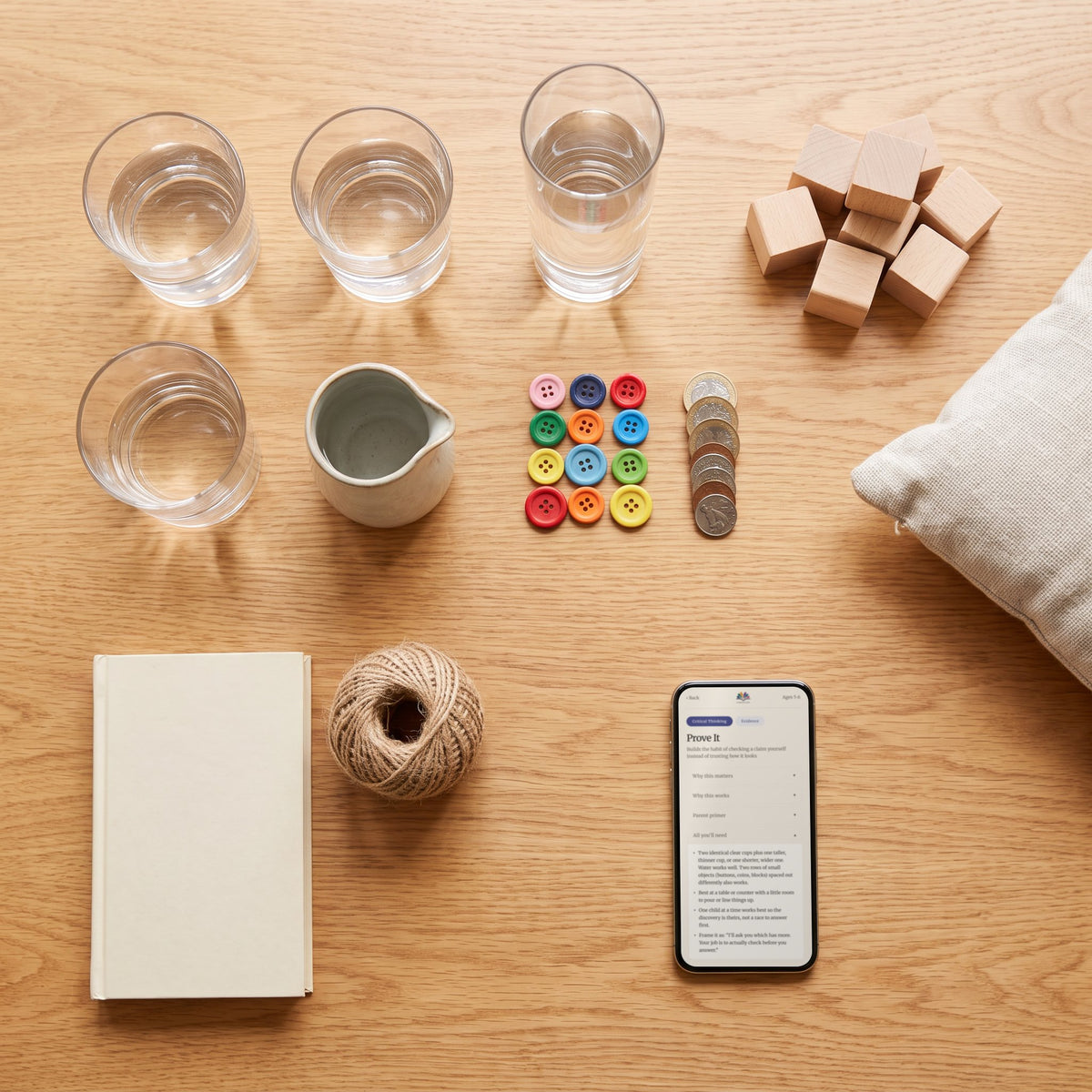
A tall, thin glass of water looks like more than a short, wide one holding the same amount. Prove It turns that trick into practice at checking a claim yourself instead of trusting how it looks.
Checking with your senses was the whole test at 3 and 4: does it feel rough, does it taste sweet. That test gets trickier by 5 and 6, because sometimes the senses themselves get fooled. A tall, thin glass of water looks like more than a short, wide one holding the exact same amount. Learning to check instead of trust the first impression is a jump forward.
A lot of what looks true isn't, on first glance. The habit of actually checking, pouring it back, lining it up, counting it out, rather than accepting how something appears, is the same instinct your child will need later for every confident-sounding claim that doesn't hold up once you look closer.
Jean Piaget's classic experiments on what he called conservation found that young children often judge amount by appearance: a taller glass looks like more water, even when nothing was added or removed. Piaget originally placed this understanding later in childhood, but a well known 1974 study by Steven Rose and Marion Blank found that when the test dropped a subtle trick in the original method, repeating the question a second time, which had been silently signaling "your first answer was wrong" to children, many 5 and 6 year olds could already tell the amounts were equal.
What matters for this activity is the practical version of that finding: the instinct to double check, to pour it back and look again rather than trust the first glance, is exactly what this age is ready to practice on purpose.
References: Piaget, J. (1952), The Child's Conception of Number; Rose, S.A. & Blank, M. (1974), "The Potency of Context in Children's Cognition: An Illustration Through Conservation," Child Development, 45.
You'll be tempted to explain why the amounts are actually equal, or not, before your child checks. Don't. Let them find out by doing the check themselves: pouring it back, lining objects up, counting them out. The finding lands harder when it's theirs.
Mix in claims that are actually true along with the tricky ones. If every round is a trick, your child will just learn to say "they're the same" every time without really checking, and that defeats the point.
If your child gets fooled by the appearance and doesn't catch it, that's normal, not a gap to fix today. Show them the check calmly and let curiosity carry it, not correction.
- They ask to check before you've suggested it. "Wait, let me pour it back" or "let me count" without prompting.
- They can tell you why they were fooled, not just that they were. "I thought it was more because it was taller" is the specific, useful version.
- They start doubting their first glance on their own, saying "it looks like more, but let's check" before you ask.
- Two identical clear cups plus one taller, thinner cup, or one shorter, wider one. Water works well. Two rows of small objects (buttons, coins, blocks) spaced out differently also works.
- Best at a table or counter with a little room to pour or line things up.
- One child at a time works best so the discovery is theirs, not a race to answer first.
- Frame it as: "I'll ask you which has more. Your job is to actually check before you answer."
1.Fill two identical cups with the same amount of water, side by side, so your child can see they start equal.
2.Pour one into a taller, thinner cup while they watch. Ask: "Which has more now, or are they the same?"
3.Let them answer based on how it looks first. Then ask: "How could you check?" and let them come up with pouring it back, rather than telling them.
4.Pour it back into the matching cup together and compare. Ask: "Was your first answer right?"
5.Repeat with an unequal pair (pour a little out this time), so they learn the check matters both ways, not just as a trick that always ends in "they're the same."
Which one has more, or are they the same?
the opening question, asked before any checking happens.
How could you check?
use once they've answered. Push them toward a method, don't hand them one.
Was your first answer right?
use after the check. Names the gap between what it looked like and what it was.
Right level looks like: they're willing to change their answer after checking without getting frustrated at being wrong the first time, and they start suggesting the check themselves.
Make the shape difference more dramatic to start, then ease it down, or run a round with no trick at all to see if they still check anyway.
Use objects lined up instead of liquid. Physically moving and counting objects is easier to track than watching water change shape.
If they're still going, try one of these.
- Let them set up the trick for you. Building the illusion themselves requires understanding exactly why it fools people.
- Try it with weight instead of amount. A big soft pillow versus a small hard book: which is actually heavier? Check by holding both.
- Keep a running tally of times the first guess was right versus wrong across a few days, and talk about what that tells them about trusting first impressions.
Watch for it when your child questions something that looks bigger or more and stops to check instead of assuming. A sibling's slice of cake that looks larger because it's cut differently. That pause to check is the skill showing up outside the activity.
Final thoughtThe first glance is often wrong in some small way, and the child who checks anyway ends up right more often than the child who doesn't.
Twenty-nine more like this, across all six skills.
30 purposefully designed activities
Every activity is built the same way, so you always know what you’re doing and why.

-
One skill, one habit
Each activity trains a single habit inside one of the six skills, so you know what you’re building.
-
The research, in plain language
A short note on the study behind it: who ran it, what they found, and what it means at your child’s age.
-
Things you already have
Household objects or nothing at all. No printing, no shopping, no setup.
-
Clear steps and what to say
Numbered steps and play prompts you can read once and run straight away.
-
A primer for you
What to expect at this age, the instinct to hold back on, and the signs the skill is showing up.
-
Easier, harder, further
How to adjust when it’s too easy or too hard, and ideas for when your child wants more.
What parents say
-
5 out of 5
My kids are loving this!
Simple games, easy to follow and lots of variation when I'm stuck for what to do.
-
5 out of 5
Nice Job Team
Parent tips are a nice touch to steer the game back in the right direction if it's getting off track
-
5 out of 5
just what i was looking for
wasn't so easy to find an activity book that uses research. so glad i found this
How we compare
Thirty activities, each built around a named skill and the research behind it, and each small enough for five minutes of an ordinary day.
| What you get | Raising Future Thinkers | Free ideas online | Typical activity book |
|---|---|---|---|
| Built around | Six named skills, five habits each, taught in order | Whatever turns up in a search | Usually a theme or a season |
| The research | Every activity names the study behind it, in plain language | Rarely sourced | Sometimes a general note at the front |
| Age fit | Written for one age band, so every activity fits | Often "ages 3 and up" | Often a wide range, like 3 to 8 |
| Time and materials | Five minutes, with things you already have | Varies, often printables or supplies | Often a materials list to gather first |
| Help for you | What to notice, and how to make it easier or harder | Usually the instructions only | Usually the instructions only |
| Progress | See which skills you've worked on | Nothing to track | Rarely |
| What comes next | The next age's guide grows the same six skills | Start the search again | A new book with a new approach |
Any last questions?
Do I need special skills or teaching experience to use this?
Do I need special skills or teaching experience to use this?
Not at all. Each activity is written in clear, simple steps, with prompts to help if your child gets stuck. You don’t have to prepare lessons or explain complex ideas, you just show up and play together. The learning happens naturally through fun.
What if my child isn’t interested in the activities?
What if my child isn’t interested in the activities?
Children learn best when they’re having fun and following their own interests. That’s why the guide is flexible. You can skip, adapt, or repeat activities depending on what excites your child that day. And for every activity, we've included helpful tips and prompts to keep everyone engaged.
How do I know these activities are actually effective?
How do I know these activities are actually effective?
Every activity is built around a specific core skill supported by child development research. The methods, like storytelling, open-ended play, and problem-solving, are backed by peer-reviewed studies. We’ve included references for every activity so you know this isn’t guesswork. It’s joyful play with a solid foundation.
What if I don’t have the time to add something new to our busy days?
What if I don’t have the time to add something new to our busy days?
That’s exactly why this guide was created. Most activities take 5 to 10 minutes and use things you already have at home. You don’t need to follow it in order or do everything. Pick what feels doable, even once a week. Small, playful moments are enough to make a big difference.
Why buy this when I can just find activities for free on the internet?
Why buy this when I can just find activities for free on the internet?
You absolutely can. But what this guide gives you is structure, clarity, and peace of mind. No endless scrolling or second-guessing if it’s age-appropriate or worthwhile. Instead, you get 30 ready-to-go activities, beautifully designed, research-backed, and organized so you can spend less time searching and more time connecting with your child.
How do I get the guide?
How do I get the guide?
Right after you pay, a private link appears on the thank-you page and in your confirmation email. Open it whenever you like, as often as you like. It's yours to keep.
Can I use it with more than one child?
Can I use it with more than one child?
Yes. Many activities work with siblings together, and where one child at a time works better, the activity says so. If your children are in different age bands, each band has its own guide.
Thirty activities across six skills, five minutes each.
Guides for other ages
The same six skills, with activities written for each age.

