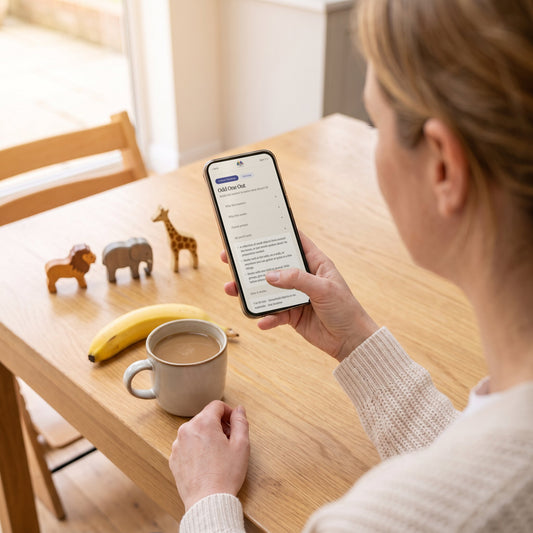
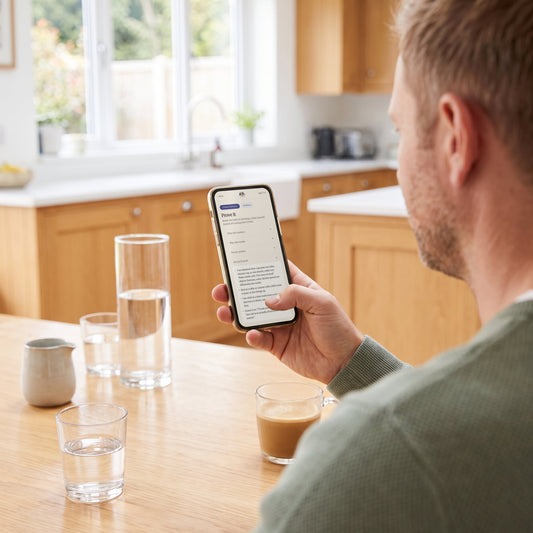
Raising Future Thinkers | Ages 11–12
Raising Future Thinkers | Ages 11–12
Thirty activities, most fifteen to twenty minutes, made for children starting to argue a case, test ideas fairly and steer their own learning.
- Includes 30 screen-free activities.
- Backed by peer-reviewed research.
- Builds core skills for a future with AI.
- Simple, fun & easy to follow.
Couldn't load pickup availability
- Sent instantly
- No subscription
- Yours to keep
Raising Future Thinkers | Ages 11–12
About this guide
About this guide
Eleven- and twelve-year-olds can argue a point, test an idea one factor at a time and start to steer their own learning. This guide puts that to work in thirty activities, most fifteen to twenty minutes, across the six skills research points to as lasting human strengths in a world shaped by AI.
Every activity follows a method that was tested with children around this age: an argument on cards and paper where the other side's best points get answered, a lucky charm put to a fair test, paper helicopters tested one change at a time. Some are quick games, and a few are weekly routines worth keeping.
What’s inside
What’s inside
- 30 activities across six core skills: Critical Thinking, Systems Thinking, Creative Thinking, Adaptability, Curiosity and Emotional Intelligence.
- Most take fifteen to twenty minutes, with household objects or nothing at all. Try The Lucky Charm Test with a coin and a watch, or Which Factors Matter? with paper helicopters on the stairs.
- The research behind every activity, in plain language.
- What to notice, the questions to ask, and how to make each activity easier or harder.
- Progress tracking, so you can see which skills you've worked on.
How you get it
How you get it
A private link appears on the thank-you page and in your confirmation email. It's yours to keep.
The research
The research
Every activity ends with a short note on the research behind it: the study, who ran it, and what it means at your child's age, in plain language.


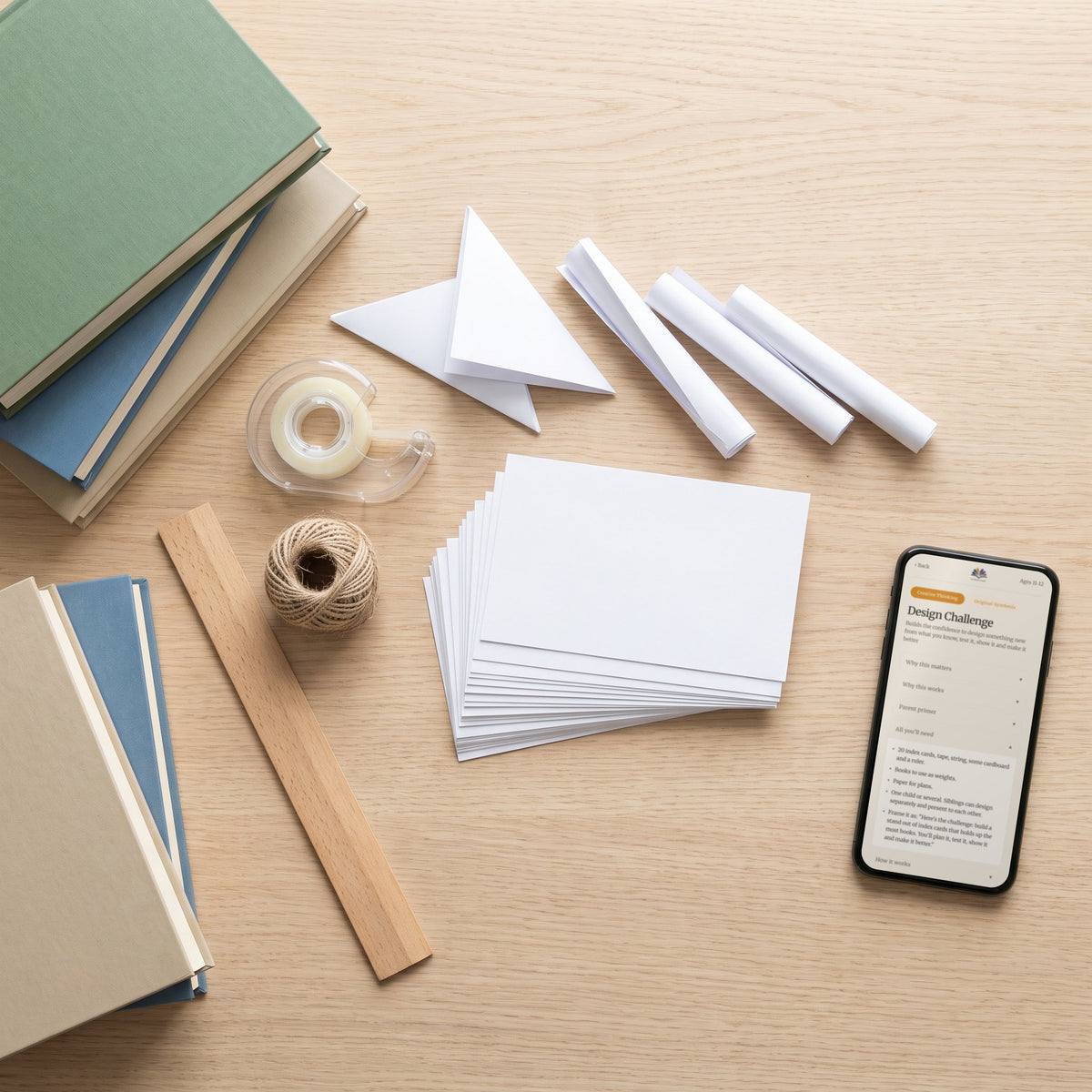
Try one activity
One of the thirty, taken from the guide. Try it today.
Like What?
Friends are like a good umbrella. Roots are like a city's water pipes. The farther apart the two ideas, the better, as long as you can say what they share.
"Roots are like… a city's water pipes." "Friends are like… a good umbrella." Joining two things that don't seem to belong together is where a lot of new ideas come from. The farther apart the two things are, the more surprising the link, and the more you have to think to find it.
Last year your child borrowed ideas from animals to invent new things. The leap is now made in the head instead of on paper, linking ideas that seem far apart and explaining what they share.
Maite Garaigordobil, a psychologist at the University of the Basque Country, ran a creative play program with 10- and 11-year-olds in Spain: one two-hour session a week for a whole school year, compared with classes that did regular art lessons. One game, "remote associations," gave teams of four unfinished sentences like "Friends are like…", "The sun is like…" and "Roots are like…". Each child had to complete at least one with an original link, with examples to start them off, such as "a pine tree is like a rocket." Teams read their links aloud, and every game ended with a short discussion.
Children in the program became significantly more original with words, coming up with ideas their classmates didn't, compared with children who weren't in it. The gains came from the whole program, which included many games, not this one alone.
References: Garaigordobil, M. (2006), "Intervention in Creativity With Children Aged 10 and 11 Years: Impact of a Play Program on Verbal and Graphic-Figural Creativity," Creativity Research Journal, 18(3); Garaigordobil, M. (2006), "Efectos del juego en la creatividad infantil: Impacto de un programa de juego cooperativo-creativo para niños de 10 a 12 años," Arte, Individuo y Sociedad, 18.
Take the first link and ask for a second one. The first idea is usually the obvious one.
Always ask "How?" A link counts when your child can say what the two things share.
Play along and make some of your own links clumsy. It shows that trying matters more than being clever.
- Their links move from obvious ("The sun is like a lamp") to surprising ("The sun is like a grandmother: it keeps everyone going without asking").
- They explain what the two things share without being asked.
- They start making links in conversation, unprompted.
- Index cards, each with an unfinished sentence: "Friends are like…", "Roots are like…", "A library is like…", "Rain is like…", "A clock is like…", "Homework is like…"
- A pencil.
- Two or more people. Families and siblings are ideal.
- Frame it as: "Let's find the strangest thing these could be like, as long as you can explain why."
1.Read out a few examples to set the bar: "A pine tree is like a rocket." "A tree's branches are like arms reaching for the sun."
2.Deal one card to each person. Everyone writes at least one ending, as surprising as they can.
3.Read the endings aloud. After each one, the others ask: "How?"
Example: "Roots are like a city's water pipes. How? They're hidden underground and carry water to everything above."
4.For each card, go around again for a second, stranger link.
5.Talk about which links surprised you most, and what made them work.
Like what?
to start each card.
How are they alike?
after every link.
Can you find one even farther away?
once they've made a good link.
The right level: your child makes links that surprise you and can explain each one.
Draw two cards with random words, like "volcano" and "friendship," and make a link that joins them.
Start with links between things that are physically alike, like shapes or colors, before moving to ideas.
If they're still going, try one of these.
- Use one of the best links to invent something: if roots are like pipes, what could you design?
- Find links in books you're reading and talk about why the writer chose them.
- Keep a "Like what?" jar of unfinished sentences for long car rides.
You'll hear it when your child says "This line is like a slow snake that keeps eating people." They're joining ideas that don't usually go together.
Final thoughtNew ideas often come from noticing what two very different things have in common.
Twenty-nine more like this, across all six skills.
What does the future ask of your child?
AI is changing how people learn, work and solve problems, and the tools will keep changing as your child grows up. Nobody can say exactly what work will look like twenty years from now. What research can point to is which human skills keep their value as AI takes on more.

Six skills, five activities each
The skills research points to as lasting human strengths in a world shaped by AI. Tap a skill to read how the guide teaches it.
-
Critical Thinking
Who made it, compared with what, what's the other side?
Five activities built on methods tested with children this age: the choices behind a package, your turn as the teacher, a fair comparison, the case that breaks the rule, and both sides argued well.
-
Systems Thinking
Test it fair, play it forward, see the whole.
Five activities that work like real science: a lucky charm put to a fair test, a loop map, a forest played forward ten years, loops that grow or settle, and a park seen whole.
-
Creative Thinking
Look again, change the facts, design, test, redesign.
Five activities, most of them regular practice: one object seen five ways, far-apart ideas linked, a problem's facts changed, your own work checked against goals, and a design tested and redesigned.
-
Adaptability
It gets easier, ask yourself first, plan for the obstacle.
Five activities for a year of big changes: an older child's story, a brain that grows with practice, three questions for when you're stuck, a question left open, and a plan for the obstacle.
-
Curiosity
Storm the questions, invent the rule, steer your own learning.
Five activities where your child drives: a storm of questions, a dull topic made personal, one factor tested at a time, a rule invented from cases, and learning they plan and steer.
-
Emotional Intelligence
The exact feeling, the second layer, every side of the story.
Five activities for the early teens: the exact feeling in a song, the second layer behind words, every side of a story, a path to next-year self, and a check on what you understood.
How each skill builds
Six skills, five activities each. The activities build on each other, but you can do them in any order. When all thirty feel easy, the next guide grows the same tree a step further.
- Noticing
- Questioning
- Evidence
- Assumptions
- Evaluating Reasoning
- Cause & Effect
- Connections
- Ripple Effects
- Feedback Loops
- Whole vs Parts
- Generating Options
- Combining Ideas
- Reframing
- Iteration
- Original Synthesis
- Tolerating Change
- Trying Again
- Pivoting
- Ambiguity Comfort
- Self-Regulation
- Wondering
- Exploring
- Investigating
- Connecting Dots
- Self-Directed Learning
- Naming Feelings
- Reading Others
- Perspective-Taking
- Self-Awareness
- Metacognition
30 purposefully designed activities
Every activity is built the same way, so you always know what you’re doing and why.

-
One activity, one focus
Each activity develops one part of one of the six skills, so you know what you’re building.
-
The research, in plain language
A short note on the study behind it: who ran it, what they found, and what it means at your child’s age.
-
Things you already have
Household objects or nothing at all. No printing, no shopping, no setup.
-
Clear steps and what to say
Numbered steps and play prompts you can read once and run straight away.
-
A primer for you
What to expect at this age, the instinct to hold back on, and the signs the skill is showing up.
-
Easier, harder, further
How to adjust when it’s too easy or too hard, and ideas for when your child wants more.
What parents say
-
5 out of 5
My kids are loving this!
Simple games, easy to follow and lots of variation when I'm stuck for what to do.
-
5 out of 5
Nice Job Team
Parent tips are a nice touch to steer the game back in the right direction if it's getting off track
-
5 out of 5
just what i was looking for
wasn't so easy to find an activity book that uses research. so glad i found this
How we compare
Thirty activities, each built around a named skill and the research behind it, and each small enough for five minutes of an ordinary day.
| What you get | Raising Future Thinkers | Free ideas online | Typical activity book |
|---|---|---|---|
| Built around | Six named skills, five activities each, that build on each other | Whatever turns up in a search | Usually a theme or a season |
| The research | Every activity names the study behind it, in plain language | Rarely sourced | Sometimes a general note at the front |
| Age fit | Written for one age band, so every activity fits | Often "ages 3 and up" | Often a wide range, like 3 to 8 |
| Time and materials | Five minutes, with things you already have | Varies, often printables or supplies | Often a materials list to gather first |
| Help for you | What to notice, and how to make it easier or harder | Usually the instructions only | Usually the instructions only |
| Progress | See which skills you've worked on | Nothing to track | Rarely |
| What comes next | The next age's guide grows the same six skills | Start the search again | A new book with a new approach |
Any last questions?
Do I need special skills or teaching experience to use this?
Do I need special skills or teaching experience to use this?
Not at all. Each activity is written in clear, simple steps, with prompts to help if your child gets stuck. You don’t have to prepare lessons or explain complex ideas, you just show up and play together. The learning happens naturally through fun.
What if my child isn’t interested in the activities?
What if my child isn’t interested in the activities?
Children learn best when they’re having fun and following their own interests. That’s why the guide is flexible. You can skip, adapt, or repeat activities depending on what excites your child that day. And for every activity, we've included helpful tips and prompts to keep everyone engaged.
How do I know these activities are actually effective?
How do I know these activities are actually effective?
Every activity is built around a specific core skill supported by child development research. The methods, like storytelling, open-ended play, and problem-solving, are backed by peer-reviewed studies. We’ve included references for every activity so you know this isn’t guesswork. It’s joyful play with a solid foundation.
What if I don’t have the time to add something new to our busy days?
What if I don’t have the time to add something new to our busy days?
That’s exactly why this guide was created. Most activities take 5 to 10 minutes and use things you already have at home. You don’t need to follow it in order or do everything. Pick what feels doable, even once a week. Small, playful moments are enough to make a big difference.
Why buy this when I can just find activities for free on the internet?
Why buy this when I can just find activities for free on the internet?
You absolutely can. But what this guide gives you is structure, clarity, and peace of mind. No endless scrolling or second-guessing if it’s age-appropriate or worthwhile. Instead, you get 30 ready-to-go activities, beautifully designed, research-backed, and organized so you can spend less time searching and more time connecting with your child.
How do I get the guide?
How do I get the guide?
Right after you pay, a private link appears on the thank-you page and in your confirmation email. Open it whenever you like, as often as you like. It's yours to keep.
Can I use it with more than one child?
Can I use it with more than one child?
Yes. Many activities work with siblings together, and where one child at a time works better, the activity says so. If your children are in different age bands, each band has its own guide.
Thirty activities across six skills, five minutes each.
Guides for other ages
The same six skills, with activities written for each age.