Raising Future Thinkers | Ages 9–10
Raising Future Thinkers | Ages 9–10
Thirty activities, most about fifteen minutes, made for children starting to reason about what if, weigh evidence and run their own projects.
- Includes 30 screen-free activities.
- Backed by peer-reviewed research.
- Builds core skills for a future with AI.
- Simple, fun & easy to follow.
Couldn't load pickup availability
- Sent instantly
- No subscription
- Yours to keep
Raising Future Thinkers | Ages 9–10
About this guide
About this guide
Nine- and ten-year-olds can reason about what if, weigh evidence and stick with a plan for weeks. This guide puts that to work in thirty activities, most about fifteen minutes, across the six skills research points to as lasting human strengths in a world shaped by AI.
Every activity follows a method that was tested with children around this age: a painting talked through with three questions, someone else's experiment checked for fairness, a month-long project run one small goal at a time. Some are quick games, and a few are weekly routines worth keeping.
What’s inside
What’s inside
- 30 activities across six core skills: Critical Thinking, Systems Thinking, Creative Thinking, Adaptability, Curiosity and Emotional Intelligence.
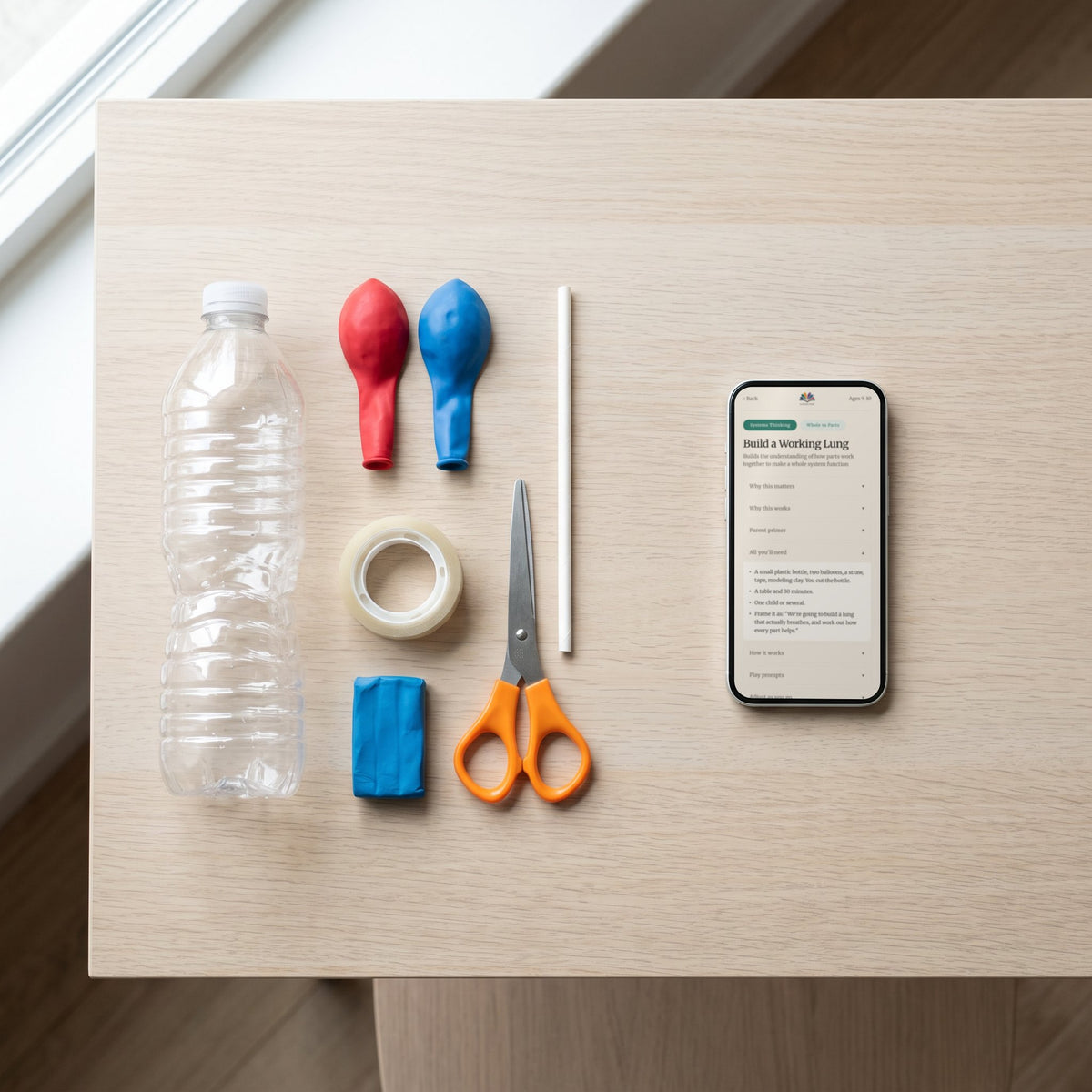
- Most take about fifteen minutes, with household objects or nothing at all. Try Does It Work Backwards? in the car, or Build a Working Lung with a bottle and two balloons.
- The research behind every activity, in plain language.
- What to notice, the questions to ask, and how to make each activity easier or harder.
- Progress tracking, so you can see which skills you've worked on.
How you get it
How you get it
A private link appears on the thank-you page and in your confirmation email. It's yours to keep.
The research
The research
Every activity ends with a short note on the research behind it: the study, who ran it, and what it means at your child's age, in plain language.


Try one activity
One of the thirty, taken from the guide. Try it today.
Does It Work Backwards?
If it's raining, the grass gets wet. The grass is wet. So it rained? Most people say yes, and finding the sprinkler is the whole activity.
"If it's raining, the grass gets wet. The grass is wet. So it rained." It sounds right, and most people say yes. But it rests on a hidden assumption: that rain is the only thing that wets grass. The sprinkler could have been on.
People slip in this assumption constantly: "If you're good at math, you'll like puzzles. She likes puzzles, so she must be good at math." At 9 and 10, your child can learn to spot it by looking for another way the second thing could be true. Once they know the trick, they'll catch it in arguments everywhere.
In a 2016 study, Maria Christoforides and colleagues trained 8- and 11-year-olds in Cyprus to handle exactly these "if... then" traps. Children were taught the structure of these arguments and how to test them by looking for a case that contradicts the conclusion. Reasoning improved in step with how much training children received.
The researchers also found the gains came through children becoming aware of how the argument was built. This activity makes that structure visible: write the rule, flip it, and hunt for the case that breaks it.
References: Christoforides, M., Spanoudis, G., & Demetriou, A. (2016), "Coping With Logical Fallacies: A Developmental Training Program for Learning to Reason," Child Development, 87(6).
Expect your child to fall for the first few. Most adults do too. Say so, and laugh about it.
You'll want to explain the rule up front. Let them get caught once, then hunt for the other explanation together. The "aha" sticks better.
- They pause before answering and ask "is there any other way that could happen?"
- They find the counterexample themselves: "The sprinkler!"
- They spot the same pattern in something someone says in real life.
- Paper and pencil.
- A handful of "if... then" puzzles (examples below).
- One child or several.
- Frame it as: "Some arguments sound right but sneak in a hidden assumption. Let's catch it."
1.Read a puzzle and ask for a quick answer.
Example: "If it's raining, the grass gets wet. The grass is wet. Did it rain?" (Most kids say yes.)
2.Write the rule as two boxes with an arrow: Rain → wet grass.
3.Ask: "Does the arrow work backwards? Could the grass be wet without rain?" Hunt for other causes: sprinkler, dew, a spilled bucket, the dog.
4.Name the hidden assumption together: "We assumed rain was the only way."
5.Do four or five more, mixing ones that are fine with ones that aren't.
Example: "If it's a dog, it has four legs. My pet has four legs. Is it a dog?" (Could be a cat.) "If it's a dog, it has four legs. Rex is a dog. Does Rex have four legs?" (Yes, that one works.)
Does the arrow work backwards?
after each puzzle. The core question.
Can you think of another way that could happen?
to hunt for the case that breaks it.
What were we assuming?
once they find it. Name the assumption in a sentence.
The right level: your child gets caught sometimes, and can always find the counterexample once asked.
Use real-life arguments: "Everyone who wins the spelling bee practices a lot. I practice a lot. So I'll win."
Stick with physical examples you can act out or draw, like wet grass and sprinklers.
If they're still going, try one of these.
- Make up an "if... then" trap and try it on someone in the family.
- Find one in a story or a fable, where a character jumps to a conclusion.
- Collect true "if... then" rules that do work backwards, like "if it's a square, it has four equal sides."
You'll hear it when your child says "Wait, that doesn't mean she's angry. She could just be tired." They've caught the assumption that there was only one explanation.
Final thoughtAsking "could it happen another way?" catches more hidden assumptions than any other question.
Twenty-nine more like this, across all six skills.
What does the future ask of your child?
AI is changing how people learn, work and solve problems, and the tools will keep changing as your child grows up. Nobody can say exactly what work will look like twenty years from now. What research can point to is which human skills keep their value as AI takes on more.

Six skills, five activities each
The skills research points to as lasting human strengths in a world shaped by AI. Tap a skill to read how the guide teaches it.
-
Critical Thinking
Look closely, ask how they know, weigh the reasons.
Five activities built on methods tested with children this age: a painting looked at closely, who said it and how they'd know, what a claim is based on, hidden assumptions caught, and reasons weighed together.
-
Systems Thinking
Test it fair, follow the dominoes, find the cycle.
Five activities that make systems visible: an unfair test spotted, the rain followed to see where it goes, effects falling like dominoes, a decay cycle watched in a jar, and a working model lung.
-
Creative Thinking
More ideas, borrowed from nature, seen through other eyes.
Five activities, most of them weekly family games: many drawings from three shapes, inventions borrowed from animals, a problem seen through other eyes, three drafts with feedback, and a picture turned into a show.
-
Adaptability
Find another way in, keep at the hard ones, step back.
Five activities with a move for when plans wobble: coping ideas sorted, effort praised, five ways into a stuck problem, two ways to estimate, and a hot moment seen from a distance.
-
Curiosity
Big questions, a good mystery, a month of your own.
Five activities where your child steers: big questions with no answer key, a mystery that starts the exploring, a data set they collect themselves, two towers compared, and a month-long project of their own.
-
Emotional Intelligence
The exact feeling, the hidden meaning, the other side.
Five activities for a more social age: feelings that are close cousins, what someone thinks and means, the other side of an argument said out loud, strengths with evidence, and knowing versus feeling familiar.
How each skill builds
Six skills, five activities each. The activities build on each other, but you can do them in any order. When all thirty feel easy, the next guide grows the same tree a step further.
- Noticing
- Questioning
- Evidence
- Assumptions
- Evaluating Reasoning
- Cause & Effect
- Connections
- Ripple Effects
- Feedback Loops
- Whole vs Parts
- Generating Options
- Combining Ideas
- Reframing
- Iteration
- Original Synthesis
- Tolerating Change
- Trying Again
- Pivoting
- Ambiguity Comfort
- Self-Regulation
- Wondering
- Exploring
- Investigating
- Connecting Dots
- Self-Directed Learning
- Naming Feelings
- Reading Others
- Perspective-Taking
- Self-Awareness
- Metacognition
30 purposefully designed activities
Every activity is built the same way, so you always know what you’re doing and why.

-
One activity, one focus
Each activity develops one part of one of the six skills, so you know what you’re building.
-
The research, in plain language
A short note on the study behind it: who ran it, what they found, and what it means at your child’s age.
-
Things you already have
Household objects or nothing at all. No printing, no shopping, no setup.
-
Clear steps and what to say
Numbered steps and play prompts you can read once and run straight away.
-
A primer for you
What to expect at this age, the instinct to hold back on, and the signs the skill is showing up.
-
Easier, harder, further
How to adjust when it’s too easy or too hard, and ideas for when your child wants more.
What parents say
-
5 out of 5
My kids are loving this!
Simple games, easy to follow and lots of variation when I'm stuck for what to do.
-
5 out of 5
Nice Job Team
Parent tips are a nice touch to steer the game back in the right direction if it's getting off track
-
5 out of 5
just what i was looking for
wasn't so easy to find an activity book that uses research. so glad i found this
How we compare
Thirty activities, each built around a named skill and the research behind it, and each small enough for five minutes of an ordinary day.
| What you get | Raising Future Thinkers | Free ideas online | Typical activity book |
|---|---|---|---|
| Built around | Six named skills, five activities each, that build on each other | Whatever turns up in a search | Usually a theme or a season |
| The research | Every activity names the study behind it, in plain language | Rarely sourced | Sometimes a general note at the front |
| Age fit | Written for one age band, so every activity fits | Often "ages 3 and up" | Often a wide range, like 3 to 8 |
| Time and materials | Five minutes, with things you already have | Varies, often printables or supplies | Often a materials list to gather first |
| Help for you | What to notice, and how to make it easier or harder | Usually the instructions only | Usually the instructions only |
| Progress | See which skills you've worked on | Nothing to track | Rarely |
| What comes next | The next age's guide grows the same six skills | Start the search again | A new book with a new approach |
Any last questions?
Do I need special skills or teaching experience to use this?
Do I need special skills or teaching experience to use this?
Not at all. Each activity is written in clear, simple steps, with prompts to help if your child gets stuck. You don’t have to prepare lessons or explain complex ideas, you just show up and play together. The learning happens naturally through fun.
What if my child isn’t interested in the activities?
What if my child isn’t interested in the activities?
Children learn best when they’re having fun and following their own interests. That’s why the guide is flexible. You can skip, adapt, or repeat activities depending on what excites your child that day. And for every activity, we've included helpful tips and prompts to keep everyone engaged.
How do I know these activities are actually effective?
How do I know these activities are actually effective?
Every activity is built around a specific core skill supported by child development research. The methods, like storytelling, open-ended play, and problem-solving, are backed by peer-reviewed studies. We’ve included references for every activity so you know this isn’t guesswork. It’s joyful play with a solid foundation.
What if I don’t have the time to add something new to our busy days?
What if I don’t have the time to add something new to our busy days?
That’s exactly why this guide was created. Most activities take 5 to 10 minutes and use things you already have at home. You don’t need to follow it in order or do everything. Pick what feels doable, even once a week. Small, playful moments are enough to make a big difference.
Why buy this when I can just find activities for free on the internet?
Why buy this when I can just find activities for free on the internet?
You absolutely can. But what this guide gives you is structure, clarity, and peace of mind. No endless scrolling or second-guessing if it’s age-appropriate or worthwhile. Instead, you get 30 ready-to-go activities, beautifully designed, research-backed, and organized so you can spend less time searching and more time connecting with your child.
How do I get the guide?
How do I get the guide?
Right after you pay, a private link appears on the thank-you page and in your confirmation email. Open it whenever you like, as often as you like. It's yours to keep.
Can I use it with more than one child?
Can I use it with more than one child?
Yes. Many activities work with siblings together, and where one child at a time works better, the activity says so. If your children are in different age bands, each band has its own guide.
Thirty activities across six skills, five minutes each.
Guides for other ages
The same six skills, with activities written for each age.